What Is the Everest Base Camp Trek?
The Everest Base Camp trek is a ~130 km round-trip walk from Lukla to the foot of Mount Everest at 5,364 m (17,598 ft) and back, through Nepal's Khumbu region. The trail climbs through Sagarmatha National Park, passing Namche Bazaar, Tengboche Monastery, and the Khumbu Glacier's moraine. Nine of the trip's 12–14 days are trekking days. Jump to the cost breakdown if budget is your first question.
Two Base Camps exist, and search results mix them up. South Base Camp (5,364 m, Nepal) is the trekking destination this page covers. North Base Camp (5,150 m, Tibet) is a road-accessible stop on Tibet overland tours: a vehicle trip, not a trek. One more boundary: trekking to Base Camp is not climbing Everest. The $40,000+ figures you see online belong to summit expeditions, a different undertaking with different permits, gear, and risk.
Which route variants exist?
Four established variants reach the same destination:
- Classic EBC trek: 14 days, the standard route both ways. The version this page plans.
- EBC via Gokyo Lakes: 13+ days, adds the turquoise Gokyo lake chain and Gokyo Ri.
- Three Passes trek: 18 days, crosses Kongma La, Cho La, and Renjo La. The hard version.
- Heli-return trek: 11 days, walk up, fly back from the Kala Patthar area.
The route is fixed geography. What varies is what you pay to walk it.
How Much Does the Everest Base Camp Trek Cost?
A guided Everest Base Camp trek costs $1,250–1,800 per person for a standard 14-day package, including permits, Lukla flights, teahouse lodging, meals, and a licensed guide. The full market spans $950 for bare-bones support to $5,000 for luxury lodges. Solo trekkers pay a premium; groups of four or more get the best per-person rates.
The table itemizes a mid-range budget:
| Item | Typical cost (USD, 2026) | Notes |
|---|---|---|
| Guided 14-day package | $1,250–1,800 | Permits, flights, lodging, meals, guide included |
| Lukla flights (if booked solo) | $238 KTM / $188 Ramechhap one-way | ~$400 return all-in |
| Permits | $40–50 combined | Two permits; see permits |
| Nepal visa | $50 | 30 days, on arrival |
| Travel insurance | $100–250 | Must cover 6,000 m + helicopter evacuation |
| Tips | $100–200 total | ~$15/day guide, ~$8/day porter, per group |
| Drinks, wifi, charging, showers | $200–400 | Prices rise with altitude |
| Water | $1–2/L low, $3–6/L high | Boiled teahouse water: NPR 150–450/L |
Uninsured helicopter evacuation from Gorak Shep runs $4,000–6,000. Insurance is the one line item you do not trim.
Three cost behaviors separate smooth treks from stressful ones. First, cash: no reliable ATMs operate beyond Namche Bazaar, so trekkers carry Nepali rupees from Kathmandu for every on-trail extra. Second, the altitude gradient applies to prices, not just oxygen: a $2 water bottle in Lukla costs $5 at Gorak Shep, and hot showers climb from $3 to $10 over the same distance. Third, budget figures assume the standard route; side trips, extra nights from flight delays, and gear bought last-minute in Namche (possible, at a premium) sit outside every package.
The independent-trekking math, for comparison: teahouse rooms, self-arranged flights, permits, and meals total roughly $900–1,100 before any guide or porter. The gap to a $1,250–1,800 package buys the licensed guide Nepal's 2026 rules now expect, porter support, booked rooms in peak season, and rebooking labor when Lukla weather intervenes. The spread is real; what it purchases is mostly risk removal.
What moves the price?
Five variables set your final number:
- Group size: solo pricing runs ~40% above 4–6-pax rates.
- Service level: porter-per-trekker ratios, room class, KTM hotel nights.
- Season: peak windows (October–November, March–May) price highest.
- Trek length: the 11-day heli-return costs more despite fewer days; helicopters are the reason.
- Guided vs independent: independent trekking cuts the package fee but Nepal's 2026 guide rules make a licensed guide the planning assumption. Details under permits.
Fixing these five variables early turns a price range into a price. A defined package does exactly that.
EBC Trek Packages: Classic, Heli-Return, Gokyo, and More
An Everest Base Camp trek package includes Lukla flights, both permits, teahouse lodging, three meals per trekking day, a licensed English-speaking guide, and porter support. Excluded, almost always: international flights, Nepal visa, insurance, drinks, tips, and personal gear. Verify both lists before paying anyone.
The packages this site's planning connects to are operated by Himalayan360, a Kathmandu operator rated 5/5 on TripAdvisor, "Excellent" on Trustpilot, and 5/5 on Google Reviews:
| Package | Days | From (pp) | Best for |
|---|---|---|---|
| Everest Base Camp Trek | 14 | $1,260 | First-timers; the standard plan |
| EBC Trek + Helicopter Return | 11 | $2,150 | Tight schedules; skip the descent |
| Gokyo Lake Trek | 13 | $1,200 | Lakes and Gokyo Ri over Base Camp itself |
| Everest Three High Pass Trek | 18 | $1,485 | Experienced trekkers; the full circuit |
| EBC Helicopter Tour | 1 | $1,070 | See EBC without trekking |
| Everest Mountain Flight | 1 hr | $215 | The budget aerial option |
Group-size tiers apply to all trekking packages: the 14-day classic drops from $1,815 solo to $1,290 per person in groups of 13–20.
The heli-return tradeoff in one line: $890 extra buys back 3 days, replacing the two-day descent with a 45-minute flight. Worth it for fixed return dates; not for tight budgets.
Our trek began at Lukla with our seasoned guides who had in-depth knowledge of the trail, coupled with a genuine passion for the region.
Get an exact quote for your dates
Every package books the same core days on the trail. Those days follow.
How Long Is the Everest Base Camp Trek?
The Everest Base Camp trek takes 12–14 days door to door from Kathmandu, with 9 trekking days and 2 built-in acclimatization days. The standard 14-day plan:
| Day | Stage | Sleep altitude | Hours |
|---|---|---|---|
| 1 | Arrive Kathmandu | 1,400 m | — |
| 2 | Fly Lukla, trek to Phakding | 2,610 m | 3–4 |
| 3 | Phakding → Namche Bazaar | 3,440 m | 6–7 |
| 4 | Acclimatization day, Namche | 3,440 m | 3–4 hike |
| 5 | Namche → Tengboche | 3,860 m | 5–6 |
| 6 | Tengboche → Dingboche | 4,410 m | 5–6 |
| 7 | Acclimatization day, Dingboche | 4,410 m | 3–4 hike |
| 8 | Dingboche → Lobuche | 4,940 m | 5–6 |
| 9 | Lobuche → Gorak Shep → EBC → Gorak Shep | 5,164 m | 7–8 |
| 10 | Kala Patthar sunrise → Pheriche | 4,371 m | 7–8 |
| 11 | Pheriche → Namche | 3,440 m | 6–7 |
| 12 | Namche → Lukla | 2,860 m | 6–7 |
| 13 | Fly Kathmandu | 1,400 m | — |
| 14 | Depart | — | — |
The two "rest" days at Namche and Dingboche are working days. Each includes a high day-hike that pushes your ceiling, then returns you to a lower sleeping altitude. Skipping them is the classic error; the itinerary exists to manage altitude, not distance.
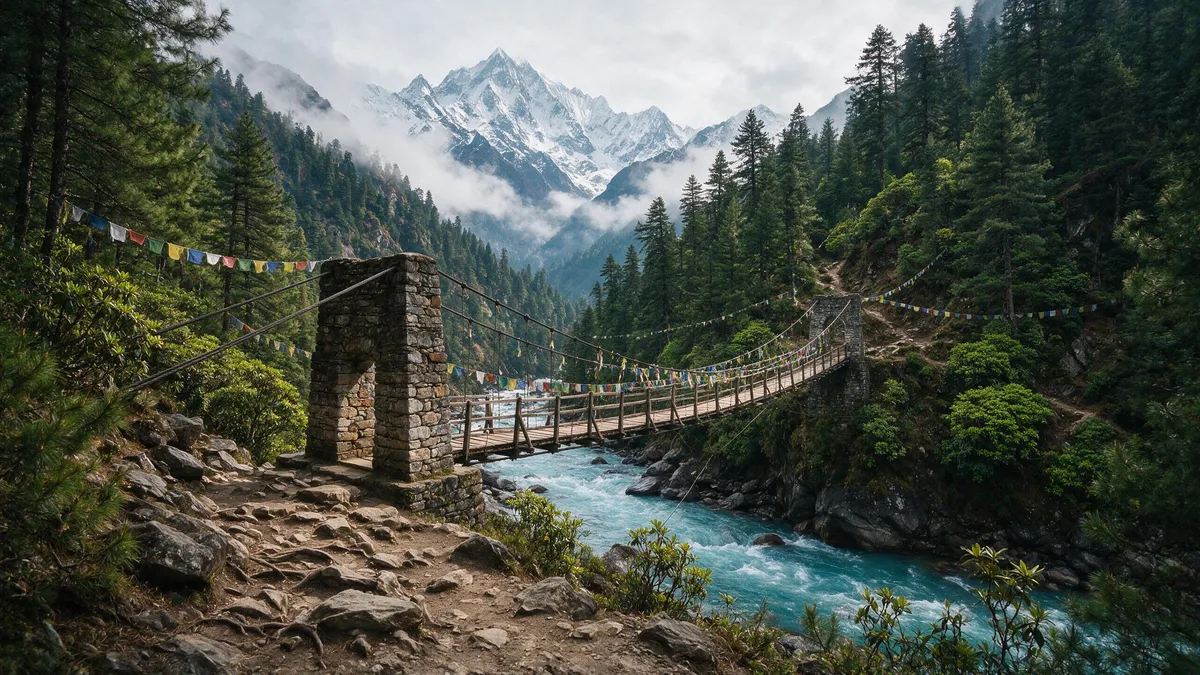
The route earns its days. Day 3 crosses the Hillary Suspension Bridge above the Dudh Koshi before the two-hour climb into Namche Bazaar, a trade town built into a natural amphitheater with a Saturday market. Day 5 ends at Tengboche Monastery, the largest gompa in the Khumbu, with Ama Dablam filling the courtyard view. Day 9 reaches Base Camp itself: in April and May, a tent city of several hundred expedition tents on the Khumbu Glacier; in autumn, the bare glacier and the prayer-flagged marker. Gorak Shep, the night's lodging, was the 1953 expedition's original Base Camp.
Faster is possible. The 11-day heli-return removes the descent. Cutting acclimatization days removes safety instead; operators that sell 10-day walking itineraries are selling elevated AMS risk. What makes the schedule non-negotiable is the difficulty profile, which is not about walking.
How Hard Is the Everest Base Camp Trek?
The Everest Base Camp trek is challenging but non-technical: no ropes, no climbing, no mountaineering skills. It is a long walk at altitudes where the air thins by half. Daily stages run 5–7 hours and 8–15 km on rocky, stepped, sometimes steep trail. The demand is repetition (nine consecutive walking days) more than any single day.
A beginner can complete it. The requirements: comfortable hiking 5–7 hours on back-to-back days with a light daypack, and the standard acclimatization itinerary. No official completion statistic exists; operators report most trekkers on 12–14-day itineraries reach Base Camp.
Train for 8–12 weeks before departure:
- Build cardio 3–4 sessions per week: hiking, stair climbing, running, or cycling.
- Add back-to-back weekend hikes of 4–6 hours with a loaded daypack.
- Walk stairs or hills with 8–10 kg from week 4 onward.
- Break in your trekking boots fully; new boots end treks.
The daily rhythm explains the demand better than any grade. Trekking days start at 7–8 am after breakfast, run 3–4 hours to a lunch stop, then 2–3 more to the night's teahouse, with arrival targeted by mid-afternoon. You carry only a daypack (water, layers, sun protection, camera) while porters move the duffel ahead. Terrain alternates between river-valley paths, stone staircases, and open moraine above Lobuche. Nothing on the standard route requires hands.
Benchmark: comparable overall demand to Kilimanjaro. EBC spends more days at altitude; Kilimanjaro compresses into one higher summit push at 5,895 m. Against the Inca Trail, EBC runs longer, higher, and colder. The dominant failure cause is ascending too fast, not lack of fitness.
How High Is Everest Base Camp, and How Do You Acclimatize?
Everest Base Camp sits at 5,364 m (17,598 ft), where each breath delivers roughly half the oxygen of sea level. Kala Patthar, the trek's true high point and viewpoint, adds another 181 m at 5,545 m. Altitude, not terrain, is the trek's defining risk, and it is managed with a protocol, not toughness.
Acute mountain sickness (AMS) can affect anyone above ~2,500 m. Early signs: headache, nausea, fatigue, poor sleep. Severe forms, HACE (brain swelling) and HAPE (fluid in the lungs), are emergencies that end treks and, untreated, lives. Fitness does not prevent AMS. Rate of ascent determines risk.
The itinerary is the prevention system:
- Two acclimatization days: Namche (3,440 m) and Dingboche (4,410 m), each with a climb-high-sleep-low day-hike.
- Slow gains above 3,000 m: sleeping altitude rises ~400–500 m per day, within accepted guidelines.
- Hydration and pacing: guides enforce both; dehydration mimics and worsens AMS.
Medication belongs in the plan, not in place of it. Many trekkers carry acetazolamide (Diamox) for altitude after consulting a doctor before departure; guides carry oximeters and check readings daily on quality treks. Neither replaces the two acclimatization days, and no tablet makes a 10-day itinerary safe.
Two related answers. The "2 pm rule" is a summit climbers' turnaround convention: reach the top by early afternoon or turn back. The trekker's version is reaching each night's teahouse by mid-afternoon, before weather closes in. And your insurance must state coverage to 6,000 m with helicopter evacuation; standard travel policies stop at 3,000–4,000 m and will not pay for a Gorak Shep airlift.
Altitude risk also has a calendar. Margins shrink in bad weather, which makes the season choice a safety choice.
When Is the Best Time to Trek to Everest Base Camp?
The best months are October–November and March–May. Post-monsoon autumn brings the clearest air of the year; pre-monsoon spring adds warmth, rhododendron bloom, and expedition activity at Base Camp itself.
| Months | Conditions | Crowds | Lukla flights |
|---|---|---|---|
| Oct–Nov | Clearest views, stable, cold nights | Peak | Mostly via Ramechhap |
| Mar–May | Warm days, blooms, some late haze | High | Mostly via Ramechhap |
| Dec–Feb | Clear and very cold (−15 °C nights up high) | Low | From Kathmandu |
| Jun–Sep | Monsoon: cloud, rain, leeches low down | Lowest | Frequent cancellations |
Winter works for cold-tolerant trekkers: quiet trails, sharp views, some teahouses on reduced service. Monsoon is the one window to avoid; the mountains hide and the flights fail. Season also decides which airport your trek starts from, the single most misunderstood logistics point on this route.
How Do You Get to the Start of the Trek?
The trek starts at Lukla (2,860 m), reached by a 30-minute flight from Kathmandu or a 20-minute flight from Ramechhap. In peak seasons (October–November, March–May), most Lukla flights operate from Ramechhap/Manthali airport, a 4–5 hour pre-dawn drive from Kathmandu, a congestion workaround at Kathmandu's airport. Off-peak, flights leave from Kathmandu directly. Fares: $238 from Kathmandu, $188 from Ramechhap, one-way, foreign nationals.
Lukla explains the caution. Tenzing-Hillary Airport operates a single sloped runway of 527 m at roughly a 12% gradient, with a mountain wall at one end and a drop at the other. Flights operate under visual rules only: no instrument landings, which is why cloud closes the airport outright. The pattern is predictable: mornings fly, afternoons deteriorate. Book the earliest slot available. Cancellation planning:
- Build 1–2 buffer days into your return schedule before international connections.
- Morning flights first; afternoon bookings carry materially higher cancellation odds.
- Helicopters fly marginal weather that planes will not: $450 per seat shared, ~$3,500 private charter.
- A road option exists (drive to Surke/Thamdanda and walk in), adding 1–2 days each way.
Packages include these flights and rebook them when weather intervenes; independent trekkers manage their own recovery. Land in Lukla and the first permit checkpoint arrives within a day's walk.
What Permits Do You Need for Everest Base Camp?
Two permits cover the standard route, checked at Lukla and Monjo:
| Document | Cost (foreigners) | Where |
|---|---|---|
| Sagarmatha National Park Entry Permit | NPR 3,000 (~$22) | Kathmandu or Monjo gate |
| Khumbu Pasang Lhamu Rural Municipality Permit | NPR 3,000 (~$22) | Lukla |
| Nepal tourist visa | $50 / 30 days | On arrival, airport |
Combined permit cost: roughly $40–50. The Jiri walk-in route adds a Gaurishankar Conservation Area permit. Packages handle all of it.
On guides: Nepal has moved to require licensed guides in the Everest region, and 2026 enforcement inside Sagarmatha National Park means you should plan on a guided trek. The rule's practical effect matches what the safety data already argued: a licensed local guide is the single highest-value line in the budget.
What Should You Pack for Everest Base Camp?
Pack in layers around one anchor item: a sleeping bag rated −10 to −20 °C. Teahouses provide beds and blankets, not warmth after sundown. Seven categories cover it:
- Layered clothing: base layers, fleece, insulated jacket, waterproof shell
- Broken-in boots plus camp shoes
- Sleeping bag (−10 to −20 °C) and liner
- Sun protection: high-altitude sun burns through cold air; glasses, cream, hat
- Water treatment: tablets or filter; untreated tap and stream water is never safe on this trail
- First aid and personal meds: plus blister care and any prescribed altitude medication
- 30–40 L daypack: porters carry the duffel, ~10–15 kg limit
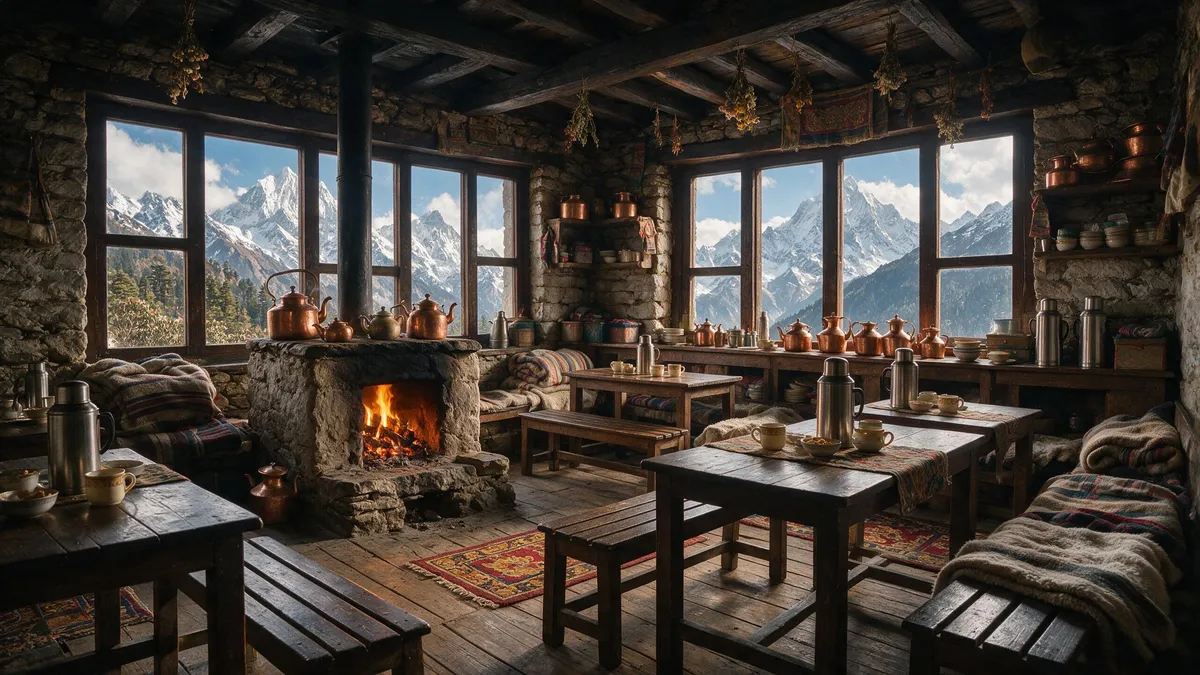
Trail life is simple: teahouse twin rooms, shared bathrooms, dal bhat that outperforms everything else on the menu, and charging, wifi, and hot showers billed per use at rising altitude prices. Rooms are unheated; the dining room's stove is the only warm space after dark, which is why the sleeping bag rating is non-negotiable. Menus repeat (rice, noodles, potatoes, eggs), and portions of dal bhat refill by custom. Namche is the last stop with real shops; forgotten gear is buyable there at a premium, and nowhere after. The budget for extras is in the cost table. Gear sorted, one question remains, the one people actually start with.
Is the Everest Base Camp Trek Worth It?
For most trekkers, yes, with the honest caveat that Base Camp itself does not show you Everest's summit. Nuptse blocks it. The payoff moment is the Kala Patthar sunrise, when Everest, Lhotse, and Ama Dablam light up across the Khumbu Glacier. The trek's value is the accumulation: nine days of the world's highest scenery, Sherpa villages, monastery mornings, and a finish line at mountaineering's most famous address.
As we trekked through diverse landscapes, I was spellbound looking at the majesty of nature, and each step felt magical... Grateful to the team at Himalayan 360 for making this trip a success with your exceptional service and expertise.
Get a trek plan
Send dates and group size — receive a tailored itinerary and exact quote. Treks from $1,260, operated by Himalayan360 (TripAdvisor 5/5 · Trustpilot Excellent · Google 5/5).
Get a trek plan
Frequently Asked Questions
- Can you see Mount Everest from Base Camp?
- No. Nuptse's wall hides the summit from Base Camp; trekkers see Everest from Kala Patthar (5,545 m) the following morning.
- Can a beginner do the Everest Base Camp trek?
- Yes. A first-time trekker with 8–12 weeks of training completes the standard 14-day itinerary; the two acclimatization days do the specialized work.
- Do planes fly over Mount Everest?
- Commercial routes avoid the summit itself; dedicated mountain flights from Kathmandu circle the range at viewing distance for around $215.
- Why does climbing Everest cost $40,000 or more?
- Those figures buy a summit expedition (climbing permits, oxygen, Sherpa support, and weeks above Base Camp), not the trek this page plans.
- What is the oxygen level at Everest Base Camp?
- Air at 5,364 m carries roughly 50% of sea-level oxygen, which is why the itinerary builds altitude exposure gradually.
- How do I book an Everest Base Camp trek?
- Send your preferred month and group size through the trek plan form; you receive a tailored itinerary and exact quote, and the operator handles flights, permits, and teahouses from there.
That is the full picture. Plan the Everest Base Camp trek with the numbers above, prepare on the 8–12-week clock, and the mountain does the rest.